
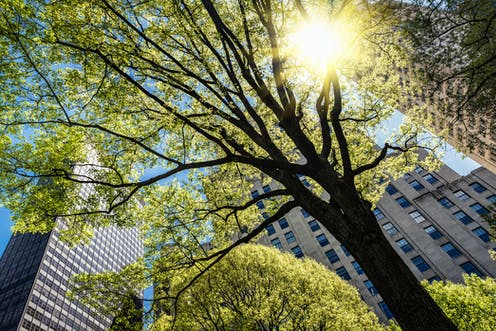
Carbon sinks are very important for our environment because they act like sponges to soak up the carbon compounds that are playing such an enormous role in global climate change. Basically, carbon sinks are holding tanks for carbon or carbon compounds, like carbon dioxide (CO2).
Green plants play a huge role in controlling CO2 levels because of the process they use to live: Photosynthesis.
Carbon is the main component of the organic matter that makes fertile agricultural soil. It also helps the soil retain water. Plants are the primary way that CO2 is transferred to soil.
Imagine if we simply combined the two in our unused or at least underutilised urban space?
Scraps of grass, gaps between buildings, forgotten pavements, derelict sites – there are acres of small unused spaces in our cities, none of which are particularly useful for development. Could the Miyawaki Method offer a solution?
The Miyawaki Method is a planting technique promoted by Japanese botanist Akira Miyawaki during the 1970s. Now the idea could provide solutions to modern challenges.
Unlike traditional methods of planting, the Miyawaki technique involves first enhancing soil quality to help retain water. Seeds are then closely dispersed across the soil; this results in a green coverage that can be up to 30 times more dense than traditional planting.
The Method is designed to be completely self-sustaining after just 2-3 years, meaning no ongoing maintenance – or cost – is required.
The result is complex ecosystems which drastically improve carbon absorption while also contributing to biodiversity. It is now being trailed in urban areas across India as a method of carbon reduction.
In urban areas, Miyawaki’s technique results in less noise and air pollution, the creation of carbon sinks, as well as the provision of natural habitats for species such as birds, butterflies, and bees in cities. Furthermore, the increased greenery improves the mental health of city residents and contributes to the overall visual aesthetic of an urban space.
The #Plant4Pakistan campaign, launching in spring 2021, will see the introduction of 51 Miyawaki sites across the city of Lahore. The urban forestry technique is growing in popularity across Asia, could it be the answer to achieving carbon neutrality in UK cities?
Although not a silver bullet, the Miyawaki Method is one that can certainly help drastically reduce carbon emissions in areas of mass pollution.
Moreover, the method will help transform derelict and unsightly brownfield sites in our cities, particularly those spaces which are too small to accommodate meaningful development.
However, transforming sites into self-sustaining mini forests is something that requires both political and economic will. These sites will not contribute to the economy directly, rather, they will be important natural spaces.
Miyawaki mini forests can also be high cost, preparing the soil and land can be expensive even though long-term maintenance is minimal.
However, the Miyawaki Method could be hugely beneficial for the environment and the vibrancy of our urban spaces, as we look to reach Net Zero. What is stopping us?


