
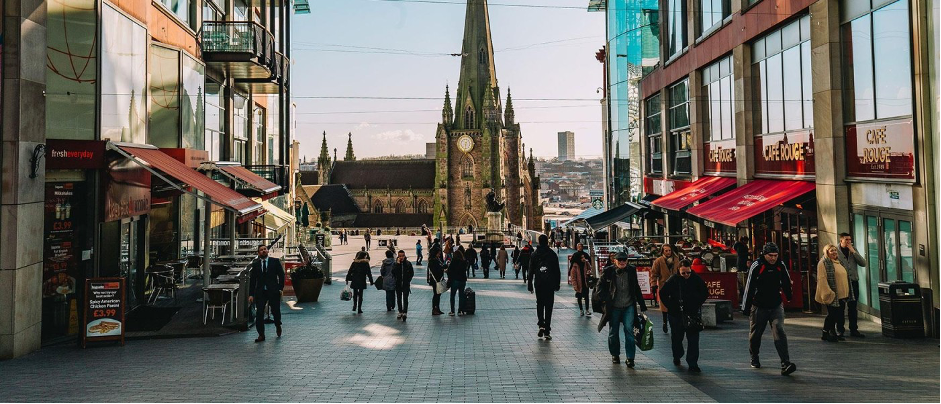
With social distancing restrictions lifted across the country and more than 75% of adults now fully vaccinated, we are witnessing what seems like a genuine return to normality.
The end of lockdown restrictions in mid-July saw people heading out freely for the first time in over a year. In Birmingham alone, we saw increased activity in pubs, nightclubs, and restaurants, with many taking advantage of the changes.
However, the medium-term result of ‘Freedom Day’ has been more underwhelming. The rate of people visiting cafes and other businesses in the hospitality sector continues to be lower than pre-pandemic levels. As a sign of continued Covid hesitancy, there appears to be a limited increase in the use of public transport.
Why hasn’t the population embraced its ‘freedom’? And what can we do to encourage more people back into city centres?
Partly, it reflects the season. The summer months are generally quieter in offices and on public transport as people take holidays and enjoy a more relaxed pace of work.
However, for many, the prospect of a crowded venue remains daunting. A recent ONS study found that more than half (57%) of people said they were worried about the lifting of social distancing restrictions. Many others have developed reclusive lockdown habits, preferring home comforts to office working.
In Birmingham, average footfall in the city has struggled to reach pre-pandemic levels. The Centre for Cities has found that our city’s footfall remains at just 46% of the pre pandemic level, one of the five weakest performers in the UK.
The friction between easing social distancing restrictions and entrenched new social behaviours must be addressed to ensure a successful emergence from the COVID-19 pandemic.
One possible solution is to increase the number of city centre events, to draw people back and encourage them to use public transport.
Since the pandemic, we have seen a rise in the number of public outdoor spaces. From ‘al fresco’ dining, pocket parks, and outdoor entertainment. Many have enjoyed these redesigned street scenes and new public areas within our city centres. They should continue to be used to attract people from across the region.
Longer term, the city can be better reconfigured for people and communities. This includes the construction of new housing across the city centre, to ensure it is a vibrant place with the social infrastructure it needs – including shops, schools, GP surgeries, and pharmacies.
Breaking down the barriers which have been set up over decades by the road network is also critical. Birmingham City Council have already made great strides but more needs to be done to ensure the city is pedestrian and cycle friendly. The 15-minute city model should remain our aspiration.
Those who operate and manage the public transport network also have a part to play. Delivering well-connected, mobile, public transport links, is obvious. However, in the short term more can be done to promote travel. Truly flexible ticketing, promotions, services with more space can all help develop confidence in the transport system. The West Midlands Combined authority has a deep pocket to support these efforts, including £363m allocated for transportation.
Ensuring our city centres remain hubs of economic activity is vital for encouraging people back to city centres. There has been a lot of debate around the rise of ‘hyper-localisation’ as those who work from home turn to their immediate surroundings for their amenities and leisure time.
However, by supporting city centres as hubs of business, innovation, and collaboration people will naturally be drawn back. This could be stimulated through the intelligent application of Business Rates both within Birmingham, and the wider region. This would require significant collaboration between the private sector, city council, combined authority, and government, but is achievable.
Innovation and change will help us in the medium to long-term. However, in the short-term – especially as we move into autumn – it is important to address the Covid concerns of many. The rise and spread of the Delta variant prove that our cities will need to live with this virus and implement changes to mitigate this danger.
For example, employers and Transport for West Midlands should continue to reiterate that public safety is paramount and highlight the safety procedures which remain in place. Hand sanitiser and face masks, while now optional, will continue to be embraced by many and should be seen as a preferred behaviour to nurture a cautious, but open environment.
How we emerge from the pandemic is driving many return and wellness strategies, but that’s not the only priority on everyone’s minds. Over the past year, there has been enormous focus given to climate action and issues of social equity. For many, wellness in the workplace now includes sustainable and healthy buildings, as well as environments that promote diversity, equity, and inclusion (DEI).
One-way landlords and employers can take on these priorities is by investing in ESG goals. Environmental, Social, and Corporate Governance, where a developer can focus and measure the sustainability and societal impact of their investments. Instead of measuring an investment based on cost or financial impact alone, with ESG, overall health is measured by the balance of these three categories.
While it will inevitably take time for many to return to city centres once again, these steps can ensure we come back stronger. Our cities are vital to our economic recovery, and we should do our utmost to help the population return to normality.


